Know No. Setting Boundaries in Your Restoration Business
Restoration Business Owners Who Know When to Say No Win More Than Those Who Say Yes to Everything
Every yes costs something.
Restoration owners learned early that availability was the job. You showed up. You answered. You handled it. That instinct built your business from nothing, and it probably saved it a few times along the way.
But saying no to the right things isn't being difficult. It's being strategic. And if you're going to play the long game... which is what July is about... you have to start here.
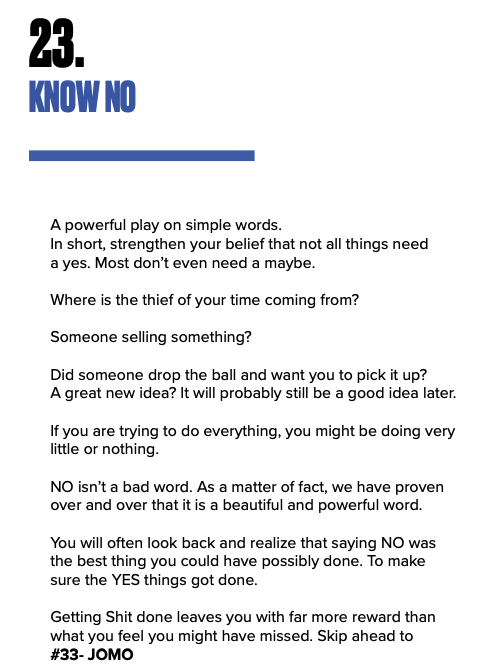
No is not a bad word. It might be the most powerful word in your business.
We believe in this value so much it made it as a marker in our popular 41 Markers book. Grab your copy here.
No Is A Positioning Move
Think about the owners you respect most. The ones who seem to have it together. The ones who move calmly while everyone else is scrambling.
They say no. Often. Not rudely. Not dismissively. Clearly.
They're not scattered by things very often. They're not doing everything that they hire others to do. They've positioned themselves around what matters and protected that position by knowing what to turn down.
Every time you say yes to something that doesn't belong on your plate, you're saying no to something that does. The emergency you stepped into because a manager couldn't handle it? That was a no to the relationship that could've added $200K this year. The adjuster meeting you insisted you sat in on? A no to the 30 minutes you needed to actually think about Q4.
The concept isn't complicated. It's just wildly uncomfortable.
No is no to one thing. Yes is no to a lot of things.
Read that again. Average owners don't feel the weight of it until they're buried. When you say yes to fielding every call, you're saying no to uninterrupted leadership time. When you say yes to every software webinar, you're saying no to the focus your best work requires. When you say yes to being the answer to every problem your team brings you, you're saying no to actually building a team that can solve its own problems.
The Pattern That Keeps Owners Stuck
Here's how it usually goes.
You're good at everything. That's why you're the owner. So when something comes up, the fastest path to resolution is through you. You handle it. Crisis averted. Everyone moves on.
It works. Once. Twice. A hundred times.
Then it becomes the culture. The standard. Not from any conversation, just from watching you... your people learn that when things get hard, the right move is to find you. You become the Google for your own company. The human FAQ. The crutch.
The dangerous "I'll just handle it" habit
At $500K, that habit builds momentum. At $2M, it starts slowing things down. At $5M+, it's the heavy anchor.
You're not doing it wrong in your mind. You're doing it the same way you always have. But what got you here isn't what gets you where you're going. The oldest truth known to every entrepreneur.
The owner who can't say no is the bottleneck. A business with a bottleneck doesn't scale... it just teaches you firsthand what burnout will feel like.
Own Your Calendar Before Someone Else Does
Here's something you can do today.
Design your week before the week designs you. That's what the Ideal Week framework is built for. It is almost the first step with our successful clients and in ROS™️.
Protected, repeating blocks your team learns to work around instead of through. Deep work. Leadership. Business development. Recovery. Placed deliberately, week over week.
When those blocks are in place, no has somewhere to stand. You're not saying no to a person. You're saying that time is already spoken for. It belongs to something that matters more.
The people who interrupt you most aren't doing so to be difficult. They're doing it because you haven't given them an alternative. When you build the structure... roles, decision rights, documented process... you give your team the answer before they come find you.
That's what R[OS] does. It's not a calendar tool. It's a system that makes you unnecessary for the things that shouldn't require you. When your people have the structure to make their own calls, your calendar opens up. And your no starts to hold.
The Long Game Starts With Your Next No
July is about strategic positioning. And you can't position yourself deliberately if your time is fully claimed by default.
The long game is making decisions today that protect where you're going... not just what's on fire right now. Being willing to disappoint someone in the short term to show up fully for what matters most.
It's simple. It's not easy.
But here's what I've seen: owners who get serious about their own limits, who stop treating availability as a virtue and start treating it as a resource, stop being the bottleneck. Their businesses start moving without them in the room.
Essential where it counts. Absent from what doesn't contribute to the goal.
The best restoration owners protect their time the way they'd protect any other asset. They've built a business where their team has what it needs to move without routing every decision upward. They know what belongs on their plate. And they've stopped apologizing for the difference.
They're generous. Deeply generous... but with intention. When they show up, they're fully there. Because they haven't scattered themselves across sixty low-leverage yeses.
That's the long game.
What the Best Restoration Owners Do Differently (and consistently)
They protect their time the way they'd protect any other asset.
They've built a business where their team has what it needs to move without routing every decision upward. They know what belongs on their plate and what doesn't. And they've stopped apologizing for the difference.
They're also generous. Deeply generous... but with intention.
When they show up, they're fully there. Phone down and facing their team directly.
Because they haven't scattered themselves across sixty low-leverage yeses.
That's playing the long game. And it starts with knowing how to say no.
If your business still needs you everywhere at once, that's not a people problem. It's a structural one. R[OS] is built for restoration companies that are ready to fix it, to install the systems, the roles, and the decision-making clarity that lets the owner step into strategic leadership instead of daily firefighting.
And if you want to do that work alongside other owners who are building the same way, Restoration Business Academy is where that community lives.
The next no you say might be the most important yes of the year.