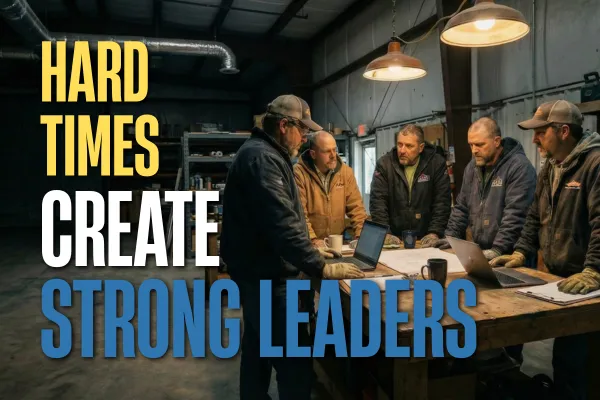
Hard Times Create Strong Leaders | 4 Lessons for Business Owners
If you run a restoration company long enough, you’ll eventually hit a season that feels like one long fight.
Not a 10-minute hiccup.
A stretch where insurance back-and-forth doesn’t just slow you down. It drains you.
Calls from adjusters that turn into voicemails.
Scope revisions that keep coming.
Updates that never move.
And if you’ve ever walked out of a meeting thinking, “What’s the point?”. Take solace in the fact that you’re not broken and you for sure are not alone.
You’re just being put through the grinder.
The leaders who come out the other side aren’t the ones who never feel the stress.
They’re the ones who learn how to lead while they’re under pressure.
Hard times don’t automatically make you great.
Your response does.
The real problem isn’t “hard times.” It’s what you do with them.
Here’s what I see most owners doing when things get tough:
They take the process personally.
They fight for payment like it’s a referendum on their character.
They burn the leadership fuel before they even realize it.
Then the calendar fills up with battlefield work.
And eventually you’re not running a company.
You’re just surviving another day of “trying to get paid by the insurance companies.”
Fatigue is understandable.
But leadership doesn’t come from comfort.
Leadership comes from clarity.
So when the pressure rises, you need a simple shift: detach from the fight, reconnect to the mission.
You’re not there to “win” a negotiation. In fact, you trying to "win" is exactly where the carriers want you. They want you distracted with the wrong fight. They are masters at thier craft. The restorers who understand this do one of 2 things... both are tied to one fact.
They either turn to compliance... and playing the game that the carriers want them to play.
OR, they just put the customer in their place and hold the customer accountable for the contract and work authorization that is signed, and make the customer do the "fighting". The thing about this approach is that the carriers have made it to feel counter intuitive... because the law of the land states, that once a debt is incurred, and its within the scope of the policy... the carrier is legally obligated to pay. End of story. (Read the book Delay Deny Defend for more details).
But i digress.
You’re there to serve the client and return the property to preloss condition (f you do reconstruction), or if you only do mitigation... to prevent the damages from continuing. Focus on that.
Step 1: Create distance so you can think again.
When you’re in the middle of a hectic schedule, it’s hard to rest and even harder to work on the business.
That’s why leaders schedule it.
Not “someday.”
A real plan.
One week each year, go offline.
Pick a location where you’re not getting calls from the office.
Use that time for two lists.
WILL DO
The habits and initiatives you’re committing to next year
The systems you’ll build (so you’re not the bottleneck)
The hiring/training changes that reduce daily chaos
WILL NOT DO
The bad habits that drain your capacity
The time-wasters you keep “accidentally” inviting in
The mindset behaviors that make every setback feel like rejection
This annual retreat isn’t a vacation.
It’s how you prevent the battlefield from becoming your identity.
Step 2: Rebuild your strategy with new approaches.
Some owners respond to hard seasons by tightening everything and hoping it gets easier.
That’s understandable.
But here’s the twist: many of the best growth moments come right after the “hard year” owners thought they’d never survive.
When you’re exhausted, you can’t afford to keep doing the same things out of habit.
So when the dust settles, take an honest inventory:
What part of your process is failing consistently?
Where are you losing time that someone else could handle?
What “old strategy” are you clinging to because it’s familiar?
Then try new things.
Run small experiments.
Measure the results.
Keep what works.
Leave what doesn’t.
Hard times often become your launchpad when you stop treating them like an ending and start treating them like a signal.
Step 3: Stop taking adjustments like they’re personal attacks.
Let’s address the emotional core.
A lot of burnout isn’t coming from the work itself.
It’s coming from the meaning you attach to the work.
You get a call, the bill gets cut, the scope gets questioned, the process stalls and your brain translates it into “They don’t respect me.”
But the truth is simpler.
Insurance companies aren’t “doing it to you as a person.”
They’re following a process.
And processes can be navigated.
You just can’t navigate them if you’re emotionally in the middle of every call.
Leaders do something very specific:
They shift their frame.
Adjusters aren’t your enemy.
They’re doing their job.
Your job is to serve the client and keep the work anchored to fair and reasonable outcomes.
That doesn’t mean you roll over.
It means you stop reacting like it’s personal.
Step 4: Teach what “professional” looks like inside your operation.
Your team watches everything.
They see what you do.
They hear your tone.
They notice how you respond when pressure hits.
If you want better leadership from your managers and crew, don’t just tell them what to do.
Model it.
A professional restoration leader:
Keeps the client front and center
Responds calmly (even when it’s annoying)
Treats adjusters as process partners, not villains
Uses documented process instead of emotional improvisation
And this is where most owners level up.
Because once you model professionalism, your standards stop depending on your mood.
Step 5: Understand the payment dynamic (client first).
This one changes how you lead.
Insurance reimbursement is not a “supplier relationship.”
Your contract and your work are with the client.
The insurance company reimburses the policyholder.
So when you’re thinking about payment, think client dynamics not personal battles.
That’s also why client onboarding matters.
If you onboard people like they’re confused passengers in a storm, you’ll end up fighting on their behalf and burning out.
If you onboard them like they’re accountable partners in the process, you unlock momentum.
Client onboarding should make it clear:
The client owes the professional
The client is responsible for holding their insurance company accountable
You’re guiding them through the process, not just chasing adjustments
When clients understand their role, your work becomes more effective.
And leaders become leaders faster.
Step 6: Qualify your clients so your business doesn’t qualify you.
Hard seasons don’t only test your systems.
They test your boundaries.
Burnout is often amplified by “bad fit” clients.
Not because the client is evil.
Because they don’t value quality, they don’t agree to prices, and they don’t commit to the process.
Leaders ask questions early:
Do they need the service?
Do they value quality?
Do they agree to pricing?
Will they advocate for fair reimbursement?
Will they handle the difference if the insurance company doesn’t?
If the answers are no, walk away.
Protect your capacity.
Protect your team.
Protect the culture you’re building.
Because your company can’t become great while it’s being dragged by people who won’t play their part.
Step 7: Know when the season is teaching you and when it’s breaking you.
Here’s the uncomfortable leadership moment:
Sometimes the issue isn’t your strategy.
Sometimes it’s your passion.
If you realize your passion isn’t intact in what you do now anymore, that’s data.
A sign to either:
Reignite it by making meaningful changes
Or build an exit strategy that protects your team and your future
Leadership isn’t only about pushing through.
It’s about making smart decisions when reality changes.
Great leaders don’t just endure.
They adapt.
The takeaway
Hard times don’t automatically create great leaders.
But pressure does expose what’s underneath.
It reveals where you’re emotionally attached to outcomes.
It reveals where you’re improvising instead of building systems.
It reveals whether your leadership is actually teachable or just dependent on your personal stamina.
So when the next hard season shows up, don’t ask, “How do I escape this?”
Ask, “What does this season demand from my leadership?”
Then lead the response.
If you want support building the systems, standards, and client education that turn chaos into clarity, start here:
